
Play-based learning means you plan the play and let the child lead: set out good materials, follow their interest, then add words, questions and one small challenge. Here are 15 low-cost ideas, five per age group, each tied to the Massachusetts guidelines and easy to adapt.
By our editors · Facts checked October 7, 2026
Disclosure: Treehouse Learning Center, which runs childcare and therapy programs in Massachusetts, publishes KidBrief. Our directory lists every licensed program, and we always label ours. Some links may be affiliate links: if you buy through them, we may earn a commission at no extra cost to you. How we make money.
The short version
- Guided play sits between free play and direct teaching. The child leads; you steer toward a goal, as NAEYC describes it.
- Boxes, scarves, cups and blocks beat gadgets. The American Academy of Pediatrics says your attention matters more than pricey toys.
- Every idea maps to EEC’s learning standards and curriculum guidelines, so it drops straight onto a lesson plan.
- Adapt anything by changing materials, cutting steps, adding pictures and gestures, and borrowing words from home languages.
What does play-based learning actually look like?
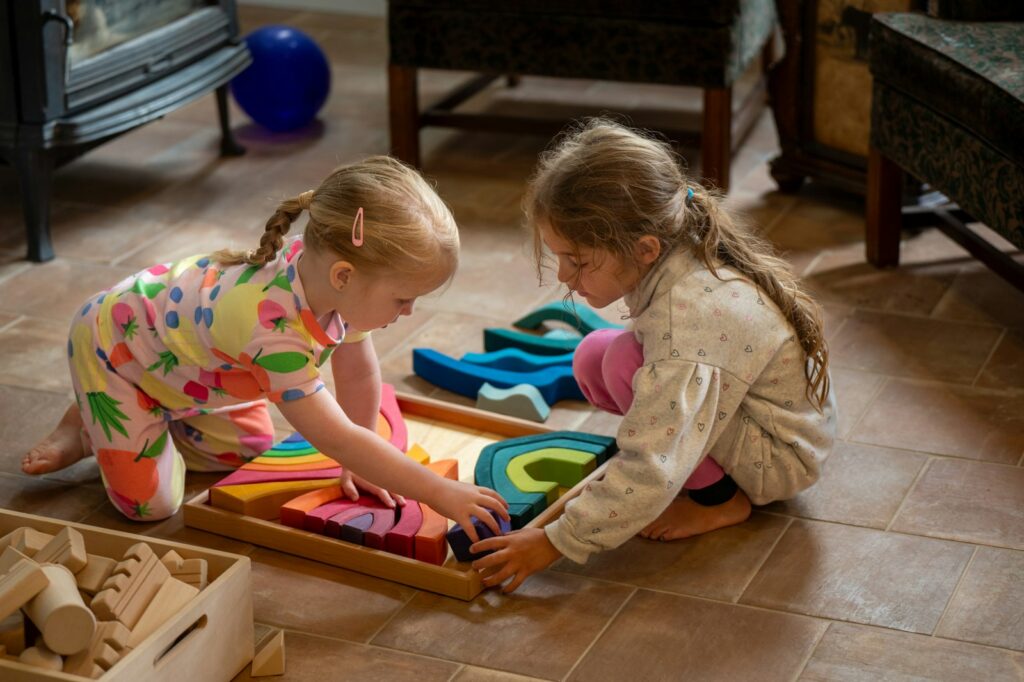
NAEYC (the National Association for the Education of Young Children) describes a range from child-directed play to adult-directed instruction. Guided play sits in the middle: the child chooses, and you comment, ask and nudge toward the next step.
Its position statement doesn’t hedge: “Play is essential for all children, birth through age 8.”
In Massachusetts, the Early Learning Guidelines for Infants and Toddlers sort skills into five domains: Social-Emotional, Language and Communication, Cognitive, Physical Health and Well Being, and Approaches to Learning.
The preschool and kindergarten guidelines, updated in 2019, add subjects such as English language arts, math, science, social studies and the arts, plus approaches to play and learning.
Infants (birth to about 15 months): faces, voices, touch
Babies learn through faces, voices, touch and movement. Check that every object is too big to swallow, and supervise closely.
| Activity | What it builds | Adapt it | Home-language tip |
|---|---|---|---|
| Back-and-forth babble. Copy the baby’s coos, then pause for a reply. | Language; Social-Emotional | For hearing loss, add facial expressions and the family’s signs. | Ask families for pet names, songs and rhymes. |
| Scarf peekaboo. Hide a toy or your face under a light scarf, then reveal it. | Cognitive (objects still exist when hidden) | For low vision, use a high-contrast or noisy toy, partly hidden at first. | Use the same short phrase every time. |
| Mirror tummy time. Set an unbreakable mirror in front of the baby during supervised tummy time. | Physical; Social-Emotional | Use the positioning the child’s physical therapist recommends; keep it short. | Name body parts in English and the family’s words. |
| Fill and dump. Offer clean containers and large blocks to drop in and dump out. | Cognitive (cause and effect); Physical (grasp and release) | Wide openings, chunky pieces, a non-slip mat. | Pair in and out with the same gesture. |
| Textures and bubbles. Touch grass and fabric scraps; reach for bubbles outdoors. | Approaches to Learning (curiosity); Physical | Let cautious babies watch first; one texture at a time. | Invite families to send a soft fabric from home. |
Toddlers (about 12 to 33 months): move, copy, pretend
Toddlers love to move, copy adults and pretend. Keep activities short and repeat them often. When the pretend play turns into grabbing or biting, our guide to handling biting, hitting and defiance in the classroom has scripts that work.
| Activity | What it builds | Adapt it | Home-language tip |
|---|---|---|---|
| Feed the baby. A doll, an empty cup and a spoon; model one pretend step. | Language; Cognitive (pretend thinking); Social-Emotional | Not pretending yet? Use real-looking props and copy what the child does. | Add bowls and food boxes from children’s home cultures. |
| Follow the leader. March, stomp, tiptoe and freeze along a path. | Physical; Approaches to Learning (listening) | Picture card for each move; a seated version for wheelchair users or tired kids. | Show each move as you say it; let a peer lead. |
| Read and act it out. A short book with a repeating line, then act it out with props. | Language and Communication | Give each child a story object to hold; add key words to a picture board. | Use books in home languages; invite a family member to read. |
| Box tunnel and towers. A big cardboard box becomes a tunnel; stack blocks to knock down. | Cognitive (problem solving, space); Physical | Lighter or soft blocks; tape the box open. | Teach up, down, more and go with signs. |
| Scoop and pour. A tub of water or sand with cups and scoops. Supervise water play at all times. | Cognitive (full, empty, more, less); Physical (hand skills) | Adjust tub height; thick handles; a scoop for kids who avoid touch. | Picture cards for full and empty in both languages. |
Preschoolers (about 3 to 5): roles, rules, real problems
Preschoolers can plan, take turns and stick with a problem. Give them roles, questions and time. These map to the subject areas in the state’s preschool guidelines.
| Activity | What it builds | Adapt it | Home-language tip |
|---|---|---|---|
| Pretend store or restaurant. Empty food boxes, paper menus, play money. | Math (counting); Social Science (buying and selling); cooperation | Picture menu and role cards; a child who uses AAC (augmentative and alternative communication) takes orders with a picture board. | Make a bilingual menu with families. |
| Nature hunt and sort. Collect leaves, rocks and sticks; sort by size, color or texture. | Science (living things, earth materials); Math (sorting) | Picture checklist and an accessible path; a child with limited grasp points while a buddy collects. | Print both languages under each picture. |
| Puppet retell. Sock or paper-bag puppets retell a familiar story. | English Language Arts (speaking, listening, story structure) | Offer a choice of two puppets; add characters to a communication board. | Let children retell in either language. |
| Ramps and rollers. Lean a board on books; test which balls and cars roll fastest. | Science and Engineering (motion); persistence and problem solving | Build at table height; bigger balls; give one child the job of saying ready, set, go. | Teach fast and slow with hand motions. |
| Freeze dance with scarves. Dance, then freeze when the music stops. | The Arts (dance, music); self-control | Hold up a stop sign at pauses; seated dancing; lower volume for sound-sensitive kids. | Invite families to share songs from home. |
What we’d use
Learning Resources Pretend & Play Calculator Cash Register
Gives your pretend store real-feeling props, including play bills, coins, a card, a scanner and a solar calculator, so kids practice counting, money words and taking turns. Ages 3 and up; the brand warns of small parts, so keep it away from children under 3.
How do I turn a play idea into a lesson plan?
Massachusetts licensing rules require a planned curriculum with goals for children’s learning, but no fancy format. Five lines do the job:
- Name the skill and the Massachusetts domain or subject area.
- List materials, free or recycled first.
- Write two or three comments or questions you’ll use to guide the play.
- Note changes for specific children, including goals from an IFSP (Individualized Family Service Plan) or IEP (Individualized Education Program).
- Decide what you’ll watch for, and jot down what you see.
Those quick notes feed your progress reports later. Our guide to cutting paperwork time shows how to write them once and reuse them.
For children who need extra support
Federal Head Start guidance lists simple ways to help any child join in: adjust the environment, adapt materials, simplify the activity, build on the child’s interests, add special equipment, or add adult or peer support.
Build therapy goals into the play you already plan; our guide to supporting IFSP and IEP goals in the classroom walks through it. And NAEYC’s position statement warns against taking away play or recess because a child needs extra support.
Children learning English may go through a silent period, which EEC’s dual language guidance notes can look like a delay. Know the typical speech milestones before you raise a concern.
Worried about a child? Share what you’ve seen with the family and suggest they talk with the pediatrician. Early Intervention evaluates children under 3; the public school district evaluates children 3 and older. More in our inclusive care section.
Common questions
Is play-based learning enough to get kids ready for kindergarten?
The Massachusetts preschool and kindergarten guidelines call a mix of child-led activities, adult-led activities and guided play developmentally appropriate. The key is intent: know the skill you’re building and watch for it. Our kindergarten readiness checklist lists what schools look for.
Do I need to buy special toys?
No. The AAP recommends simple, inexpensive objects such as blocks, containers and wooden spoons over electronic gadgets. Buy a prop only when it fills a real gap, like play money for a pretend store.
What if I don’t speak a child’s home language?
NAEYC encourages educators to value and support each child’s home language even when they don’t speak it. Use pictures and gestures, learn key words from the family, and invite families to share songs and books.
How do I show these activities meet state requirements?
State rules require a planned curriculum with learning goals and progress reports based on observation. Write the skill and domain on each plan and keep dated notes; they feed the required reports.
Get the weekly briefing · More for educators
Sources
- Developmentally Appropriate Practice Position Statement (NAEYC)
- The Power of Play: How Fun and Games Help Children Thrive (HealthyChildren.org, AAP)
- EEC Learning Standards and Curriculum Guidelines (Mass.gov)
- Massachusetts Early Learning Guidelines for Infants and Toddlers (EEC)
- Guidelines for Preschool and Kindergarten Learning Experiences (Mass.gov)
- Guidelines for Preschool and Kindergarten Learning Experiences, full text (Mass.gov)
- Preschool and Kindergarten Standards in Social-Emotional Development and Approaches to Play and Learning (Mass.gov)
- Dual Language Education Policies and Guidelines, June 2010 (Massachusetts EEC)
- 606 CMR 7.06: Curriculum and Progress Reports (Massachusetts EEC licensing regulations)
- Types of Curriculum Modifications and Embedded Learning Opportunities (HeadStart.gov)
- Pretend & Play Calculator Cash Register (Learning Resources)



Leave a Reply