
Use the same short goodbye every day, leave once you’ve said it and come back when you promised. Tears at drop-off are normal, peak between 12 and 24 months and usually fade as your child learns the routine and trusts the teacher.
By our editors · Facts checked October 7, 2026. This guide is general information, not medical advice.
Disclosure: Treehouse Learning Center, which runs childcare and therapy programs in Massachusetts, publishes KidBrief. Our directory lists every licensed program, and we always label ours. Some links may be affiliate links: if you buy through them, we may earn a commission at no extra cost to you. How we make money.
The short version
- Separation anxiety is a normal stage. It peaks between 12 and 24 months, and it’s rare for it to continue daily after the preschool years.
- A brief, warm, predictable goodbye beats a long one every time.
- Say goodbye and leave. Don’t come back unless you plan to stay.
- Prep ahead: visits, books, a comfort item and short practice separations.
- Kids who need extra support often do well with picture schedules and short stories about what will happen.
Why are goodbyes so hard?
Once babies figure out that you still exist when you leave the room, they start protesting when you go. That’s development, not a sign that child care is wrong for your child.
Here’s the age-by-age picture from the American Academy of Pediatrics (AAP) and its separation anxiety guide:
| Age | What you may see |
|---|---|
| Birth to about 7 months | Most young infants adjust well to a consistent caregiver. Some show early separation worries as young as 4 to 5 months. |
| 7 to 12 months | Stranger anxiety usually starts. Many babies show stronger separation anxiety around 9 months. |
| 12 to 24 months | Separation anxiety peaks. Many toddlers first show it at 15 or 18 months, and it can be loud. |
| Around 3 years | Kids understand more about goodbyes and are often ready to change their behavior, though drop-off can still be stressful. |
Hunger, tiredness and illness all make goodbyes harder, so know when to keep a sick child home. If you can choose your timing, the AAP suggests avoiding a first start between 7 and 12 months, or easing in gradually. Still deciding on a program? Here’s the difference between daycare, preschool and pre-K, and when kids usually start.
Before day one
- Visit the program together so your child sees that you like and trust the teacher.
- Ask the program when the best time to start is, and whether a gradual first week is possible.
- Read picture books about going to child care.
- Practice short separations with a grandparent, friend or sitter, and rehearse your goodbye.
- Pack a reminder of home, like a family photo or small comfort toy, if the program allows it.
- Talk about the new routine in simple words: “After breakfast, you’ll play with your teacher. I’ll come after nap.”
What we’d use
Mabel’s Labels Daycare Label Pack
A lovey that goes missing is a terrible start to the week. This pack has 54 personalized labels and 2 bag tags for bottles, cups, clothing, shoes and that comfort toy, and the brand says the labels are waterproof, dishwasher- and laundry-safe. Mabel’s Labels pitches it for babies and toddlers but lists no age range or small-parts warning; the labels are meant for gear, not for kids to handle.
The goodbye routine that works
Routines help kids feel safe and know what to expect, says the Centers for Disease Control and Prevention (CDC). Run the same play every morning:
- Arrive at about the same time. Same routine, same time each day, with a few minutes so you’re not rushed.
- Help your child settle. Hang up the coat, wash hands and walk to a first activity or the teacher.
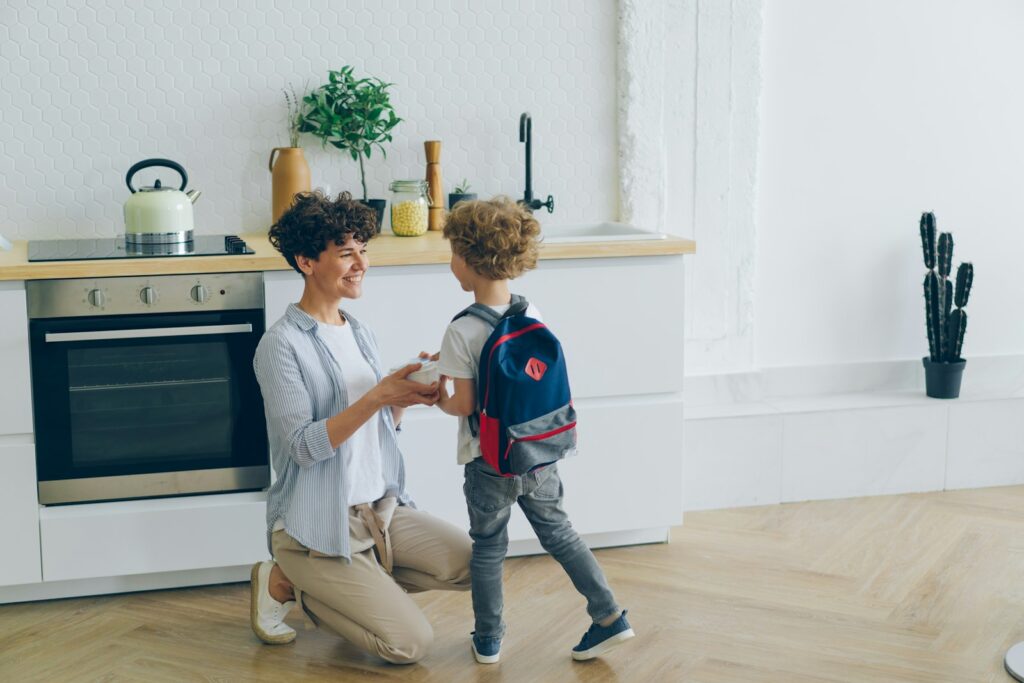
- Give your full attention for a short goodbye. A hug, a kiss and the same words each day: “I love you. I’ll be back after nap.”
- Talk in kid time. “After nap” means more to a toddler than “at 5 o’clock.”
- Leave, even if there are tears. The teacher can take over the comforting.
- Don’t reappear. Coming back, unless you’re ready to stay, restarts the goodbye.
- Come back when you said you would. Keeping that promise builds trust.
Always say goodbye instead of slipping out while your child is distracted. Say goodbye, then leave. It stings in the moment, but it teaches your child that you leave and you come back. Drawn-out goodbyes stretch the anxiety.
Surviving the first weeks
- Expect ups and downs. Illness, tiredness or a break in the routine can bring the tears back.
- Keep home routines steady. Predictable mornings, meals and bedtimes make drop-off easier.
- Ask the teacher how the day went. Find out how long the tears last after you leave and what helps your child settle.
- Make pickup calm. Greet your child warmly and give them a few minutes to switch gears.
- Flag big changes. A change of caregiver can upset a child, even when the new one is great, and so can big changes at home. Tell the program.
If mornings turn into full meltdowns, our guide to what works for toddler tantrums can help. More in our guides for families.
What should teachers do at drop-off?
Good programs plan for goodbyes. Ask about:
- A consistent primary caregiver who greets your child by name each morning.
- A predictable first activity, like a favorite toy, a book or helping set up snack.
- Picture schedules, songs or countdowns for transitions, and a “transition buddy”.
- Naming your child’s feelings with calm words: “You miss Papi. He’ll come back after nap.”
- Quick updates for you after a hard drop-off.
Still choosing a program? Add these to your daycare tour questions.
For children who need extra support
Kids with autism, speech delays, anxiety or sensory differences may find transitions extra hard. Knowing what comes next makes a big difference. As the National Center for Pyramid Model Innovations (NCPMI) puts it, “Children and families have a smoother day when children know what to expect.”
Visual schedules
A visual schedule is a short strip of pictures showing the morning in order: car, coat hook, hug, teacher, play. Use real photos of your child’s program if you can. Look at it together at home, point to each step as it happens and ask the teacher to use the same pictures.
Social stories
NCPMI describes scripted stories as short stories that pair words and pictures to explain a situation, like starting preschool. A simple one: “Mom drives me to school. I hang up my coat. Mom gives me a hug and says goodbye. I play with my friends. After nap, Mom comes back.” Read it daily before the first day and keep going during the first weeks.
What we’d use
Yoto Mini
A screen-free audio player that runs on cards. A Make Your Own card turns your own audio, like a recording of you reading your goodbye story, into a card your child can replay in the car or at bedtime. Yoto says it has no camera or microphone; its choking-hazard warning says small parts make it unsuitable for children under 3.
Other supports
- Give a heads-up before the goodbye: “Two more minutes, then hug time.”
- For a child with few words, use a sign or picture that means “Mom comes back.”
- For a child bothered by noise, ask about arriving before the room gets busy.
- If your child has an Individualized Family Service Plan (IFSP) or Individualized Education Program (IEP), ask the team to help plan the transition and share strategies with the teacher. Here’s how IFSP and IEP supports work in the classroom.
Talk with your pediatrician if your child doesn’t seem to adjust after the first weeks, or if separation worries get in the way of daily life. In Massachusetts, children under 3 can be referred to Early Intervention (EI), anyone can make the referral, and there are no out-of-pocket costs for families.
Common questions
How long does it take a child to adjust to daycare?
There’s no set timeline. Young infants often adjust well, while older babies may need extra time and support. A steady routine and a consistent teacher help most kids settle.
Is it better to sneak out when my child is distracted?
No. A short, warm goodbye said the same way every time teaches your child that you leave and you always come back. Sneaking out skips that lesson.
Should I go back if my child is still crying?
Not unless you plan to stay. Reappearing restarts the goodbye and can make the next one harder. Worried? Call the program a little later to check in.
What’s the easiest age to start child care?
Every family’s timing is different. The AAP notes most infants up to about 7 months adjust well, stranger anxiety often starts between 7 and 12 months, and separation anxiety peaks between 12 and 24 months. At any age, preparation and a steady routine help.
Looking for bilingual care or pediatric therapy on the North Shore? Our publisher, Treehouse Learning Center, has programs in Lynn.
Get the weekly briefing · See our trusted picks
Sources
- How to Ease Your Child’s Separation Anxiety (HealthyChildren.org, AAP)
- Making Baby Drop Off at Child Care Easier (HealthyChildren.org, AAP)
- Preparing Your Child for Child Care (HealthyChildren.org, AAP)
- Tips for Relying on Routines and Rules (CDC)
- Tips for Noticing and Naming Emotions (CDC)
- Family Engagement (National Center for Pyramid Model Innovations)
- Biting in Child Care (Healthy Child Care NC, UNC Chapel Hill)
- About Massachusetts Early Intervention (EI) (Mass.gov)
From the team behind KidBrief
KidBrief is published by Treehouse Learning Center, an early education program in Lynn, Massachusetts. Looking for care on the North Shore? Schedule a free tour →



Leave a Reply